![PLOV [PILAF]](https://api.heritageazculture.com/storage/uploads/1742322024_85647985.png)

PLOV [PILAF]
It is said
that there are as many varieties of pilaf as there are cities in the
Muslim world. It is a meal that unites different people, passing from
generation to generation for centuries and absorbing the traditions, culinary
features and taste preferences of different regions. Its origin is covered with
legends, and the history is closely linked to great conquerors and wise rulers.
According to
one of the versions, the recipe for pilaf came from the Persians along with the
expeditions of Alexander the Great. His warriors, impressed by the great taste
of this dish and the simplicity of its preparation, quickly took it on. Thanks
to its nourishing properties, the pilaf helped soldiers to keep their strength
in long trips.
Another
legend links the origin of the Pilaf with the great conqueror Tamerlane. Before
going to Ankara, he wondered how to feed his army without heavy trucks. One
wise mullah offered a recipe for a hearty and nutritious dish. He said to
Tamerlan: “Take a large cast-iron cossack, soaked in the fat of the old meals.
Put in it the meat of a mature ram, the rice that swells with pride, the carrot
red with joy, and the bow sharp as the sword of a warrior. Cook everything on
fire, until the smell of it reaches the heavens, and the cook looses his senses
from the divine taste». This meal gave strength to the warriors, and in each
stable they continued to cook the plov they loved so much.
There is also
another story linking the appearance of the плova with the name of the great
physician Abu Ali ibn Sina, known to us as Avicenna. According to legend, he
treated the sick son of the ruler of Bukhara and prescribed him a nutritious
dish of onion, carrots, meat, oil, salt, water and rice. The name of this dish
was formed from the first letters of ingredients: peyote (onion), ayo (carrot),
lahm (meat), olio (oil), vet (salt), oad (water) and shala (rice) - which
resulted in the word «palos», later shortened to «палos» and known as «plov» or
«pilaf»(English version).
Over time, pilaf
has spread to different countries, acquiring new flavors and ways of cooking.
In Central Asia it is prepared with a lot of carrots and spices, in Iran
they add dried fruits and saffron, in Turkey they use chickpeas and
lamb, and in India they give that meal a special flavor with spices and prepare
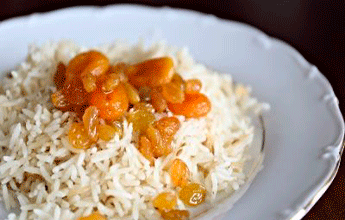
biryani - plates with multi-layered structure. In Azerbaijan pilaf is
prepared differently in different regions. There is a difference from other
types, for instance: rice is cooked separately, and meat, fruits and spices -
separately, which makes it especially crumbly and fragrant.
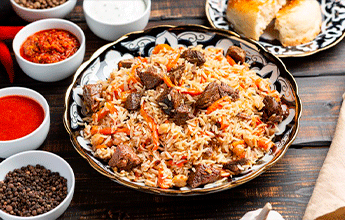
In Uzbekistan
pilaf is a national treasure. There are many varieties, but the classic one
considered to be fergana pilaf, which is prepared with yellow carrot, mutton
and curd fat. In Samarkand, the mels are served in a special way: rice remains light
and meat and carrots are placed on top.
In Iran,
the pilaf is known as «chelou» or «polo». It differs by adding saffron, dried
fruits and sometimes pistachios. It is common to serve pilaf in Iran in
combination with various types of kebab or stew. One of the most popular
options is tajit-polo, in which barberry and aive are used.
In India,
the pilaf has become a biriani - a dish enriched with spices, saffron and often
yogurt. It can be prepared with chicken, mutton or even fish. Biriani is not
just food, but a festive dish, often presented at weddings and large
celebrations.
In Turkey,
pilaf is an important part of the cuisine and is served to almost any meal.
Here it can be cooked with nuts, tomatoes, vermicelli, and also based
on meat or vegetable
broth. Turkish pilaf is also widely used in the street cuisine, where it is
served with chicken and yogurt.
In Arab
countries such as Saudi Arabia and Iraq, kabsa pilaf is popular - a
variety of pilaf cooked with the addition of spices, tomatoes and sometimes
dried fruits. Unlike the Uzbek or Persian pilaf, the Arabic version is made
from broth and has a rich flavor thanks to a mixture of spices including
cinnamon, cardamom and cloves.
Pilaf is not
just food, but a symbol of hospitality and wealth. It has a special place in
the culture of different peoples: in Uzbekistan pilafs are prepared at weddings
and major holidays, in Turkey - at memorial events, and in Azerbaijan it became
an integral part of any festive feast, and the main meal of Novruz. On this
day, the table is covered with a variety of treats, but the oilaf remains the
most important one, symbolizing warmth, well-being and abundance.
Pilaf today
is no longer just culinary treat, but a real cultural heritage that unites East
and West, antiquity and modernity, different peoples and traditions. Proving
that food is not only a means of saturation, but also an important element of
national identity. It has become a symbol of generosity, hospitality and unity
that remains an important part of the life of many nations, linking them
together through the ages.